
Ask around and you will hear everything from "one at a time, exclusively" to "blast a hundred and see what sticks". Both extremes lose, for different reasons. Here is a number to start from, the reasoning behind it, and the part almost nobody manages properly: actually keeping track of the answers.
The short answer: 5 to 10, in waves
Send to five to ten carefully chosen labels at a time, wait two to three weeks, read the results, then send the next wave. Not one, not a hundred.
Why not one? Exclusivity is a courtesy nobody asked for. A&Rs know you are shopping the track; serial single submissions just stretch a six-week process into a year of your release calendar. Save exclusivity for when a label explicitly requests a first look.
Why not a hundred? Because a demo send is only as good as its targeting, and nobody can genuinely target a hundred labels. Mass-blasting means generic emails, wrong-fit labels, and a scene small enough that carelessness gets noticed. Ten well-researched sends outperform a hundred sprayed ones, every time.
Why waves? Because each wave teaches you something: about the track, the pitch, and the list, and the next wave gets to use it. A hundred at once spends all your shots before the first lesson arrives.
Building the list of 5 to 10
- Fit over prestige. The label that put out three records adjacent to your sound beats the famous one that never has. Your one "why you" line in the submission email has to be honest, and it can only be honest with a fitting label.
- Tier the waves. Wave one: dream fits. Wave two: strong fits. Wave three: plausible fits. If wave one converts, wonderful; if not, its lessons make wave two sharper.
- Check submission preferences. Some labels want a form, a specific inbox, no attachments. Following their process is the first test, and plenty of demos fail it before a note is heard.
The tracking problem nobody talks about
Here is what actually breaks at 5 to 10 concurrent sends: your memory. Who got it when? Who opened it? Who is due a follow-up, and who already silently passed? Most artists run this on vibes and a half-abandoned note, which produces the classic errors: double-nudging one label, forgetting another entirely, re-pitching someone who already said no.
The old-school fix is a spreadsheet: label, contact, date sent, follow-up date, status. It works, and it has a blind spot the size of the whole exercise: every "status" you type is a guess. Sent is the only column you actually know.
This is where per-label tracked links quietly change the game. Send each label its own private link to the demo, and the spreadsheet fills itself with facts instead of guesses:
- Who opened, who didn't. In one glance: your ten sends sorted into "never saw it", "opened", and "listened through", each wanting a different follow-up.
- Who is listening right now. A live "playing now" tells you your track is in someone's ears at this moment.
- How deep each label went. Fifteen seconds of triage versus two full plays: which is the label to prioritize when both stay silent?
- Attribution, always. Ten links to the same track, each belonging to one label: if the track surfaces somewhere unexpected, you know which door it walked out of. It is the same leak-safe model that protects any pre-release send.
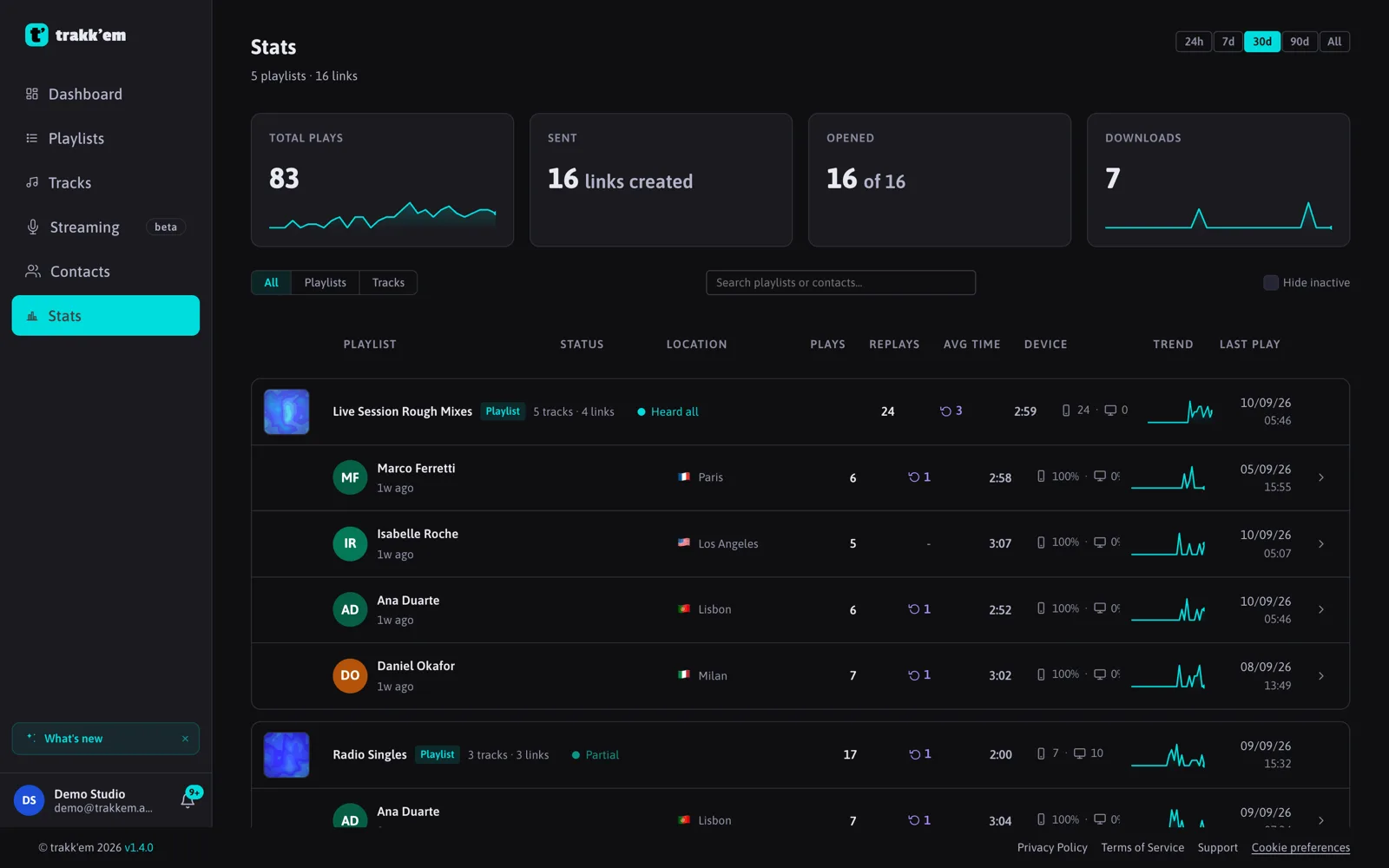
With trakk'em this is the default shape of a send: one track uploaded once, one private link per contact, and the whole wave readable on a single screen.
Reading a wave before sending the next
After two or three weeks, the wave tells you one of three stories:
- Opens but shallow listens: the track loses people early: fix the intro before spending wave two. The data even shows where they bail.
- Deep listens, no replies: the music holds attention: the fit or the moment is off. Adjust the list, not the track.
- Few opens at all: the email is the bottleneck: rework the subject and pitch before blaming the song.
That is the real answer to "how many labels": enough to learn from, few enough to respect, tracked well enough that every wave makes the next one better.
The full pitching playbook is in how to send a demo to a label. Ready to run your first wave properly? See the plans and give every label its own link.