
You sent the demo a week ago. The email was right, the track is strong, and now you are hovering over the keyboard wondering whether a follow-up makes you look professional or desperate.
Here is the reframe that makes this whole topic easier: a follow-up is not a reminder about you. It is a small service to a busy person. Done right, it costs the reader five seconds and helps them do the thing they already half-intended to do. Done wrong, it converts "haven't got to it yet" into "now I won't". The difference is timing, tone, and, more than anything, knowing which situation you are actually in.
The four situations (and why they need different moves)
Silence after a demo is not one state, it is four, and each wants a different follow-up:
- Never opened. A nudge is genuinely useful: they missed it, and you are helping it resurface.
- Opened, bailed early. That is a soft pass. A follow-up asking "did you get a chance to listen?" is awkward for both of you: they did, briefly.
- Listened fully, once. Interest may exist. Space is your friend; pressure is not.
- Listened fully, more than once. A follow-up here is not a nudge at all: it is a well-timed conversation opener.
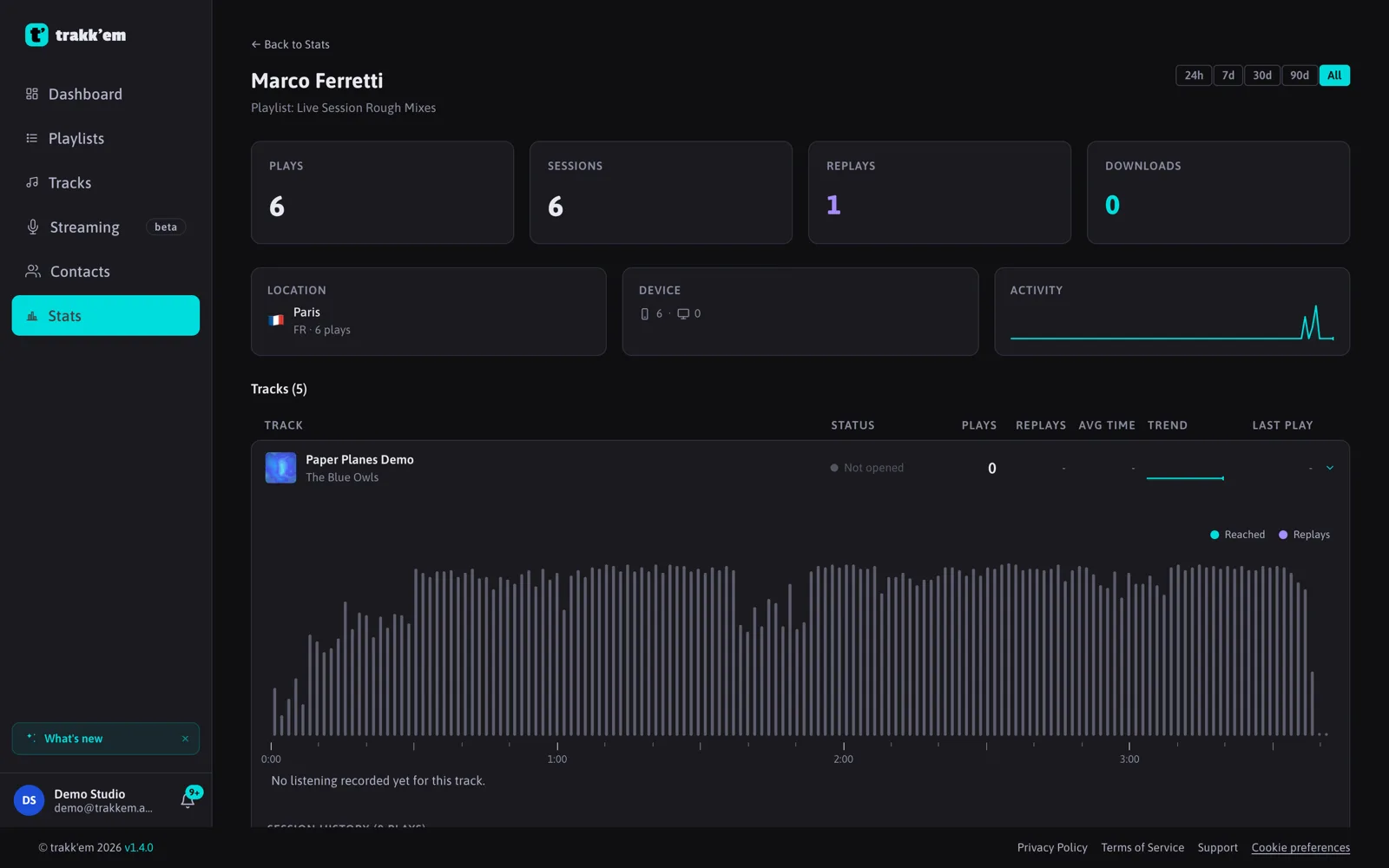
The classic problem: from the outside, all four look identical. This is exactly what a tracked, per-listener link fixes: you see opens, timing and completion per person, so you know which of the four rooms you are standing in before you speak. We covered the mechanics in did the A&R actually open your demo?
When to follow up
- First follow-up: 7 to 10 days. Earlier reads as impatience; A&R inboxes run on weekly cycles. If your link shows it was never opened, this is the useful window.
- Second (and last): 2 to 3 weeks after the first. One more, then stop. Two unanswered follow-ups is the answer.
- Instantly, only in one case: something real changed. The track got playlisted, another label made an offer, a premiere landed. News is always a legitimate reason to write.
- Never on a Friday evening. Aim for Tuesday to Thursday, mid-morning, their timezone. Boring advice, measurable difference.
What to write
Same rules as the original email: short, human, zero pressure. One line of context, one line of content, out.
If it was never opened: "Hi [name], floating this back up in case it got buried: [track] is here: [link]. No rush at all."
If they listened and you have news: "Hi [name], quick update on [track]: [the news, one line]. Link's still live if you want another listen: [link]."
If they listened fully and stayed silent: Either let it breathe, or close the loop with grace: "Hi [name], I'll take the silence as a pass on this one, no worries at all. I'd love to send the next one when it's ready."
That last one feels counterintuitive and works disproportionately well: it shows you can read a room, and it books the next send, which was always the real prize.
What never to write
- Guilt. "I know you're busy, but...", "Just checking you saw my last three emails...". Deadly.
- Fake scarcity. "Other labels are circling" (when they are not). Professionals smell it instantly.
- The re-pitch. Do not re-attach, re-describe and re-sell the same track in the follow-up. One link, one line.
- Anything sent to the wrong room. The worst follow-ups are not badly written, they are misaddressed: chasing someone who already passed, or pestering someone mid-decision.
The quiet advantage
The etiquette above is the same advice a good manager would have given you twenty years ago. What is new is that you no longer have to apply it blind. A private per-listener link tells you who opened, who finished, who came back twice, and even shows a live "playing now": so every follow-up you send is the right one, to the right person, at the right moment.
The full pitching playbook is in how to send a demo to a label.
Follow up like someone who knows. See the plans and send your next demo on a link that reports back.