
Every producer has asked the question after a lukewarm reaction: where exactly did I lose them? Was the intro too long? Did the second verse sag? Did anyone even reach the bridge? You can ask people, but listeners are polite, memories are vague, and "yeah it's cool" carries zero information.
Here is the thing: the answer exists. It is not an opinion, it is a behavior. Every listener, on every play, votes with the seek bar. They replay the parts that grab them and they jump the parts that do not. The only problem has been seeing those votes.
Feedback lies, behavior doesn't
When you ask someone what they think of your track, three filters sit between their real reaction and their answer:
- Politeness. Nobody wants to tell you the bridge is boring.
- Memory. By the time they answer, they remember the vibe, not the moment they reached for skip.
- Vocabulary. Most listeners cannot articulate why a section lost them, even when they clearly felt it.
Behavior has none of these filters. A rewind is involuntary enthusiasm. A skip is an honest "no" delivered in real time, before politeness can intervene. If you could see every rewind and every skip laid over your waveform, you would have the most honest A&R meeting of your life.
Seeing the track the way listeners heard it
This is exactly what per-section listen tracking does. Instead of one number ("played 7 times"), the track is split into small segments, and every play records which segments were actually heard, which were repeated, and which were jumped.
Stacked across listeners, a shape emerges over the waveform: a curve that rises where people replay and dips where people skip.
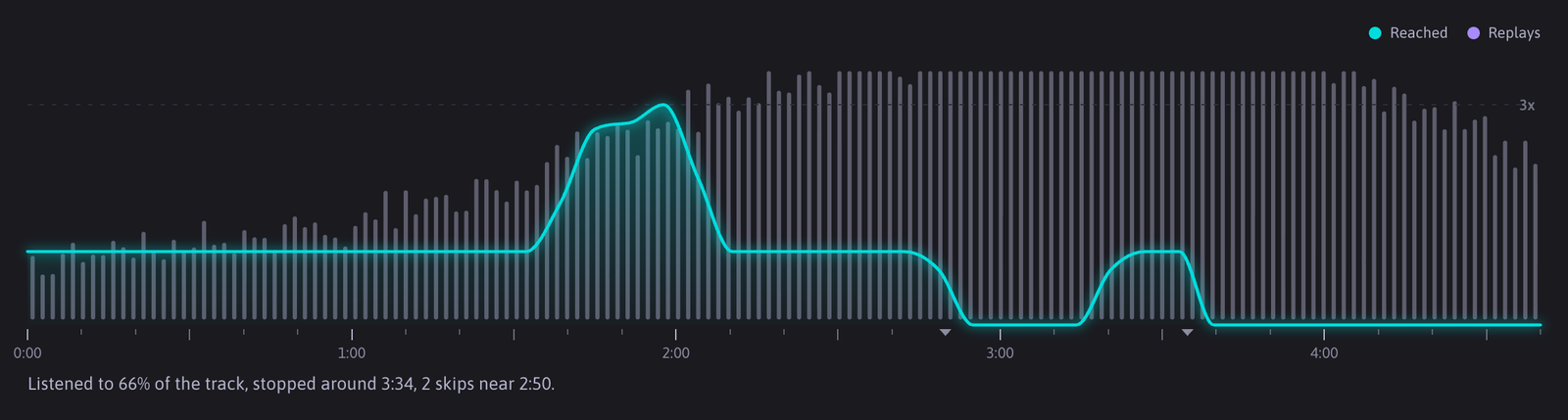
Reading it is immediate:
- A peak is your hook, as measured, not as hoped. If everyone rewinds the same eight bars, that is the moment your track is about.
- A dip is a leak. Somewhere in those bars, attention drains out. That is where your next studio session should start.
- A cliff at the start means the intro is not earning the track. If most listeners never survive the first thirty seconds, nothing after them matters yet.
- A flat, full curve is the quiet best case: people who start, finish. The track holds.
Because trakk'em tracks per listener, you can also read the same curve per person: the label heard the drop three times; the manager bailed right before it. Same song, two very different conversations to have next.
How to act on what you see
The map is only useful if it changes what you do. A few honest rules:
- Fix the biggest dip first. Not the one you suspected, the one the data shows. They are often not the same, and that gap is precisely what your own ears could not hear anymore.
- Protect the peak. The replayed section is load-bearing. Rearrange around it, get to it sooner, but do not "improve" it.
- Respect small numbers. Three listeners is a hint, not a verdict. Patterns firm up as plays accumulate; do not rewrite a bridge over one impatient phone listen.
- Compare versions. Send v2 on fresh links and watch whether the dip actually flattened. Skip data turns mixing decisions into experiments with results.
Why streaming stats can't tell you this
Public platforms show you plays, likes, maybe an audience-level retention graph if you are big enough for their analytics tier. What they cannot show you is who. A retention dip on a public platform is an anonymous crowd; a dip on a per-listener link is "the A&R skipped your second verse", which is actionable in a way a crowd average never is.
This per-section view is one layer of a bigger picture, from "did they open it" to "which bars made them stay". We walk through the whole stack in how to know if someone actually listened to your music.
Your listeners are already telling you which part of the song does not work. They have been telling you every time they touch the seek bar. All that is missing is the instrument that writes it down.
Want to see your tracks this way? See the plans and watch the curve build on your next send.