
WeTransfer and Google Drive are great software. That is not the argument here. They move files reliably, everyone knows how to use them, and they are free. Which is exactly why so much music gets sent through them, and why so much music quietly dies there.
Because here is what they are: file couriers. They deliver bytes from your computer to someone else's. And a demo is not a parcel; it is a pitch. The delivery is not the job. The reaction is the job, and a courier knows nothing about reactions.
The expiring link problem
Start with the failure everyone has experienced. A standard WeTransfer link dies after a few days. An A&R inbox runs on a longer clock than that: demos get opened the following week, the following month, on a train, whenever the listening slot finally happens.
So the timeline plays out like this: you send Monday, they open in two weeks, the link is a tombstone. Best case, they ask you to resend, and your pitch now starts with an apology. Worst case, and the far more common one, they close the tab and move on. You will never know it happened.
A pitch link should have one lifetime rule: it lives until you decide otherwise.
The zero-signal problem
The deeper failure is what happens when the link does work. Say the download completes. What do you know?
Nothing. A download is not a listen. Files pile up in a Downloads folder next to forty other demos; some get played, some never do. Drive is no better: "opened the folder" is not "pressed play", and a play in a preview window is an anonymous event you will never see. From the moment you hit send, you are blind, and blindness has a cost with a name: the follow-up you cannot write. Nudge someone who already passed, and you look pushy. Stay silent with someone who never received it, and the chance evaporates. Without data, every follow-up is a coin flip; we wrote about that trap in did the A&R actually open your demo?
The presentation problem
There is also the small matter of what the listener sees. A WeTransfer download screen. A Drive folder called FINAL MIXES. A generic file list, identical for your demo and for someone's tax documents.
None of it plays the track well either: Drive's audio preview is an afterthought, there is no artwork, no context, no sense that a human prepared this for another human. For a first impression, "here are some bytes" is a strange opening line.
What the courier can never give you
Swap the courier for a private, per-listener link and the same send starts answering questions:
- Did it arrive alive? The link does not expire, so the two-week-later open still works.
- Did they press play? You see the open, with a timestamp, attributed to the person, because their link belongs to them alone.
- Did they actually listen? Completion per play: ten seconds of triage or the full track twice.
- What did they hear? Which sections they replayed, which they skipped: mix feedback nobody had to write.
- What do they see? A clean player with your artwork and description: a delivery prepared for them, streaming your file untouched, with downloads off unless you allow them.
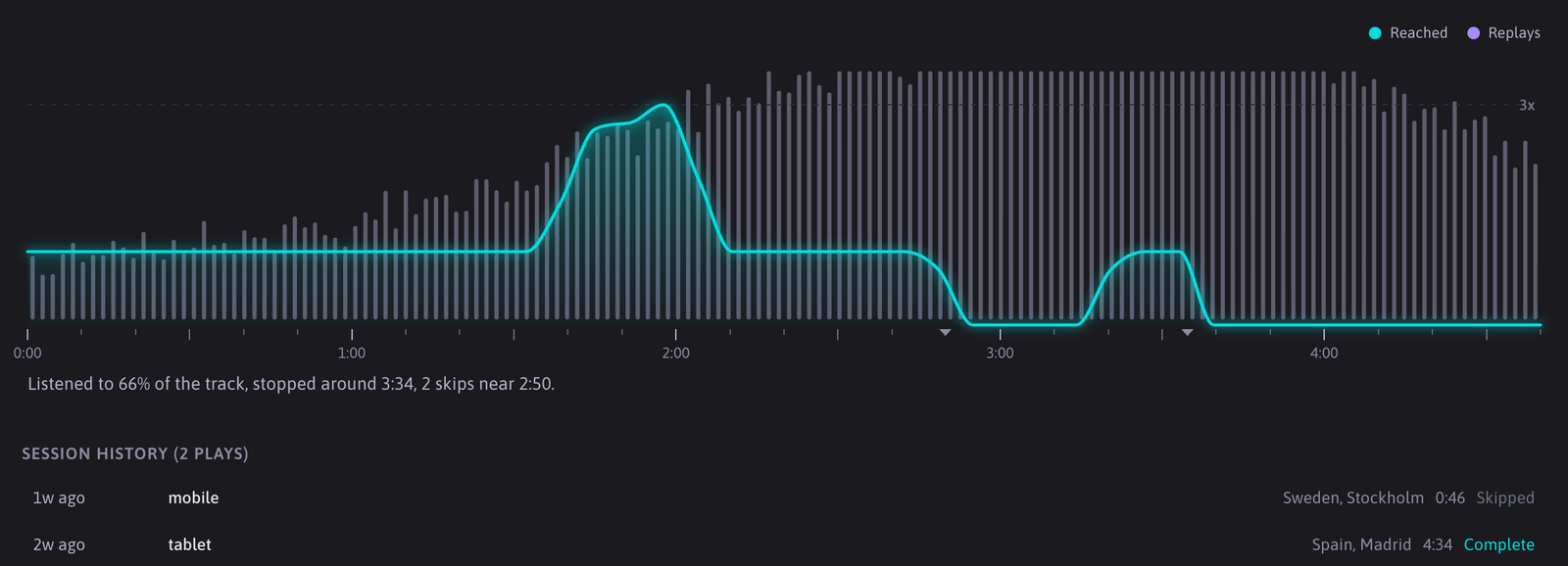
This is what trakk'em is built for: the send is the same effort, one link in an email, but the link works for you after you hit send.
Keep the courier for parcels
To be clear about scope: keep using WeTransfer and Drive. Stems to a collaborator, session folders, artwork packs, a video export: parcels, all of them, and a courier is the right tool for parcels.
But a demo is a pitch, and a pitch deserves a link that stays alive, plays beautifully, and reports back. The full pitching playbook is in how to send a demo to a label.
Next send, skip the courier. See the plans and send a link that tells you what happened.