
If you make music, you almost certainly have a SoundCloud account, so when the moment comes to send a demo somewhere, the path of least resistance is obvious: upload the track, set it to private, copy the secret link, done. It works, plenty of people do it, and for years it was the default way to pitch music.
The honest question is not whether it works. It is whether a tool built for public streaming is the right instrument for a private pitch, now that dedicated alternatives exist. Let's compare them fairly.
What a SoundCloud private link actually is
A private track on SoundCloud is a normal upload hidden from your profile, reachable through a "secret link": the URL plus a token. Anyone who has the URL can play it. That design has a few consequences worth understanding before you pitch with it:
- The secret is the URL itself. Forward the email, and the recipient's colleague, group chat, or whole team has the same access you gave one person. You cannot tell those plays apart.
- Plays are one anonymous pile. The stats say "3 plays". Was that the A&R three times, or the A&R once and two randoms from a forward? A pitch decision hangs on exactly that difference, and the number cannot answer it.
- The audio is transcoded. Streams are re-encoded for public delivery. Fine for casual listening; not what you want an A&R to judge your mix on.
- It looks like what it is. A SoundCloud page with your avatar and a waveform reads "here's my upload", not "this is a delivery prepared for you". Presentation is part of the pitch.
None of this is a flaw in SoundCloud. It is a public distribution platform doing public distribution things. The mismatch appears only when you bend it into a private delivery tool.
What a dedicated tool does differently
A dedicated private-sharing tool starts from the opposite premise: nothing is public, and every listener is known. On trakk'em the unit is not "a track with a secret URL" but a link minted for one specific person:
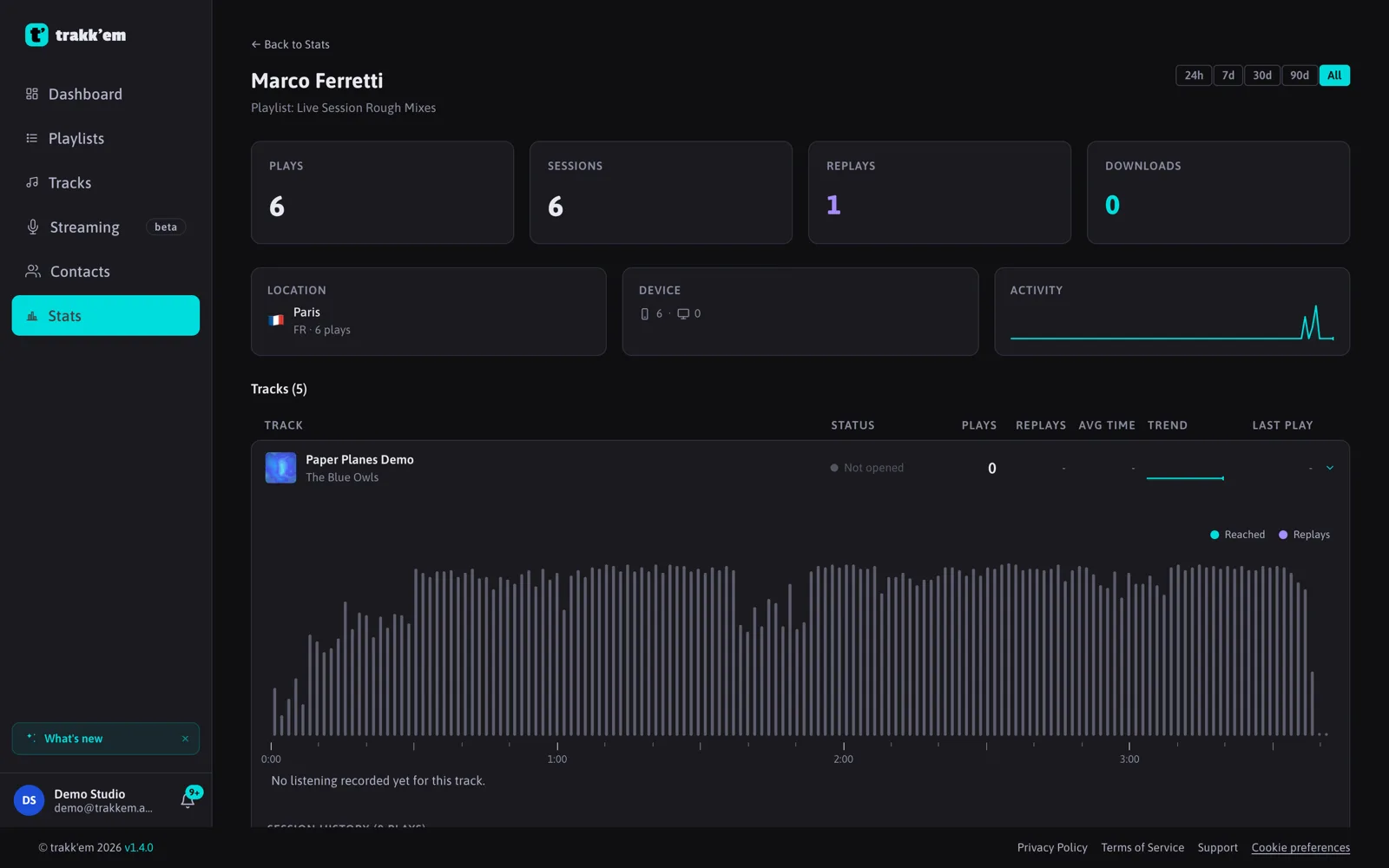
- Per-listener identity. The label's link and the manager's link are different links to the same track. Every play is attributed. A forwarded link still points back to who it was minted for.
- Real listening data, per person. Not a play count: who opened it, when, from where, on what device, how much of the track they heard, and which sections they replayed or skipped. There is even a live "playing now" view.
- Untouched audio. The file streams as you exported it: no transcoding between your mix and their ears.
- A pitch-shaped page. The listener lands on a clean, focused player carrying your artwork and description: a delivery, not a profile.
- Control per link. Downloads are off unless you allow them; expiry and passwords are per-link decisions, not account settings.
So which one, when?
Keep both tools, use each for its job.
- Use SoundCloud for what it is great at: public presence, discovery, reposts, embeds, a place where your released music lives and strangers can find it.
- Use a dedicated tool when the track is unreleased and the listener is specific: demo pitches, label submissions, mixes for clients, pre-release sharing. Any situation where who listened and how much decides your next move.
The rule of thumb is one sentence: if you care about reach, go public platform; if you care about one person's reaction, use a link that knows who that person is.
We keep a detailed side-by-side in trakk'em vs SoundCloud if you want the full feature comparison, and the pitching workflow itself is covered in how to send a demo to a label.
Your next pitch deserves better than "3 plays". See the plans and send a link that reports back.