
Somewhere along the way, we accepted a strange asymmetry. Send someone a message and you get ticks, "seen", typing indicators: a whole grammar of acknowledgment. Send someone your music, the thing you spent months on, and you get nothing. The file leaves, the silence begins.
"Read receipts for music" is the obvious idea hiding in that gap: the moment your track is actually played by the person you sent it to, you know. Not because they replied. Because the play itself is the receipt.
Why email receipts don't count
The first objection is usually "email already has read receipts". It does, and they answer the wrong question. An email receipt (or a tracking pixel, where it still works at all) says the message was rendered. It says nothing about the audio. An opened email with an unplayed track is exactly as silent as an unopened one.
A real read receipt for music has to be triggered by the music: play pressed, sound delivered, on the track you sent, by the person you sent it to. Anything upstream of that is measuring the envelope, not the letter.
What a listen receipt is made of
Get the trigger right and a listen receipt turns out to be richer than any messaging tick, because listening has depth in a way reading a text does not. A full receipt answers four questions:
- Opened: a play started, with a timestamp.
- By them: the play is attributed, because the link it happened on belongs to one named person, not to anyone holding a URL.
- This much: how far into the track they got: the difference between polite triage and genuine interest.
- These parts: which sections they replayed and which they skipped: the receipt does not just say "seen", it says what was seen.
That last level has no messaging equivalent. "Seen" is binary; listening is a curve.
What it looks like in practice
This is precisely the model trakk'em implements: every contact gets their own private link to your track, and every play on that link becomes an attributed, detailed receipt.
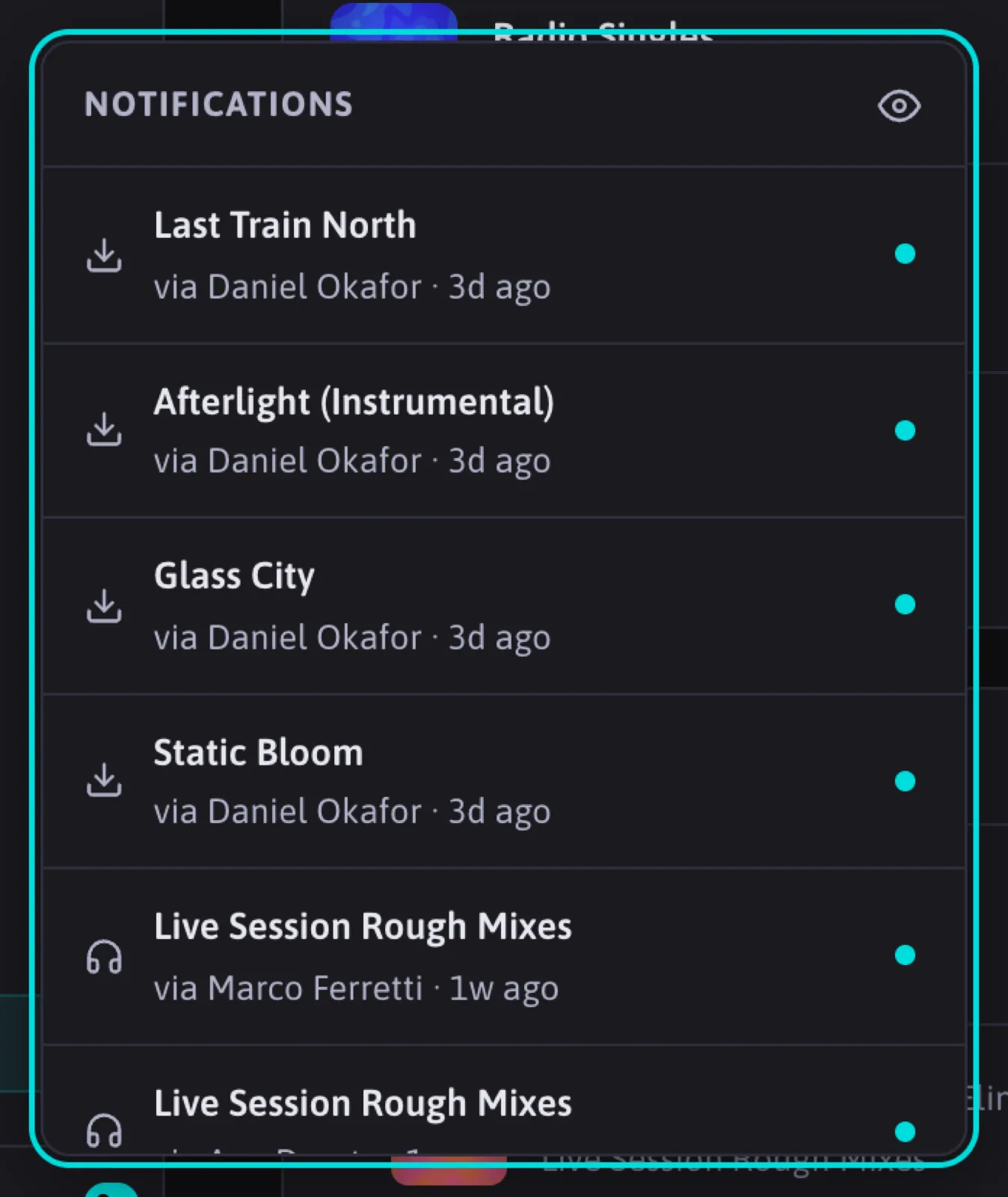
Each receipt carries the when, the rough where, the device, and the completion, and there is even a live "playing now" state: the receipt arriving while your track is in their ears. The full anatomy of what tracked listening can tell you is in how to know if someone actually listened to your music.
Why this matters more for music than for messages
For a text, "seen" mostly feeds impatience. For music sent privately, the receipt is professional infrastructure:
- It fixes the follow-up. Never opened, opened and bailed, played twice: three different receipts, three different next moves. Without them you are guessing at silence.
- It turns a "no" into information. Full listen, no reply is a real answer, and it releases you from chasing a maybe. Silence stops being ambiguous.
- It gives feedback nobody had to write. The skipped bridge and the rewound drop are craft notes, delivered by behavior.
- It keeps private sends honest. An attributed receipt means everyone holding a link knows the play is theirs: a quiet guardrail for unreleased material.
The etiquette question
"Isn't it a bit much to know?" It is worth answering plainly: this is the promo-pool model that labels and pluggers have used for decades: trackable, watermarked, attributed sends, applied to individual artists. The listener experience is a clean private player; the tracking is the sender knowing what happened to their own unreleased work. In professional contexts, both sides already assume it. What is new is not the idea. It is that it is no longer reserved for companies with promo infrastructure.
Messages got their receipts fifteen years ago. Your music, the send that actually matters, can have better ones: receipts with depth, attribution, and a curve instead of a checkmark.
Ready to get receipts on your next send? See the plans and stop reading silence.