
You sent the track. You watched the little "delivered" tick. And then nothing. No reply, no reaction, no way to tell whether it was heard once, heard twice, or never opened at all.
If you send music for a living, or you are trying to, that silence is the worst part. You are left guessing. Did the A&R actually press play, or did your email die in a folder? Did the manager hear the drop, or bail after ten seconds? A raw file gives you no answer. This guide is about getting one.
Why a normal file tells you nothing
When you send a track as an email attachment, a WeTransfer link, or a file on a shared drive, the moment it leaves your hands you go blind. Those tools are built to move bytes from A to B. They are not built to tell you what happened next.
- An attachment is downloaded, or it is not. Even if you get a read receipt on the email, that only means the message was opened, not the audio.
- A file-transfer link may show a download count, but a download is not a listen. People download and never play. People stream without downloading.
- A public streaming upload gives you a total play count across everyone, with no idea which of those plays was the person you actually care about.
The gap is always the same: you can see that you sent something, but not that anyone listened. To close that gap you need the link itself to do the reporting.
What "actually listened" really means
Before the how, it helps to be precise about what you want to know. "Did they listen" is really four separate questions:
- Did they open it at all? The baseline. A play started, on a specific link, at a specific time.
- Was it them? Not a play from somewhere, but a play from the person you sent it to.
- How much did they hear? Ten seconds and gone is very different from the whole track twice.
- Which part landed? Where they leaned in, where they replayed, and where they skipped.
Most tools cannot answer even the first. The trick is to give every listener their own tracked link, so each of these questions has a real answer instead of a guess.
Per-listener links: the one idea that changes everything
The core move is simple. Instead of one link that everyone shares, you create a separate private link for each person you send music to. One for the label, one for the manager, one for the collaborator.
Because each link belongs to one named listener, every play carries an identity. Now a play is not an anonymous number. It is "the A&R at the label opened your track on Tuesday at 9:14pm." That single change is what turns a black box into a feed of real signals.
This is the model trakk'em is built on. You upload your track once, then mint a private link per contact. What you get back, per person, looks like this.
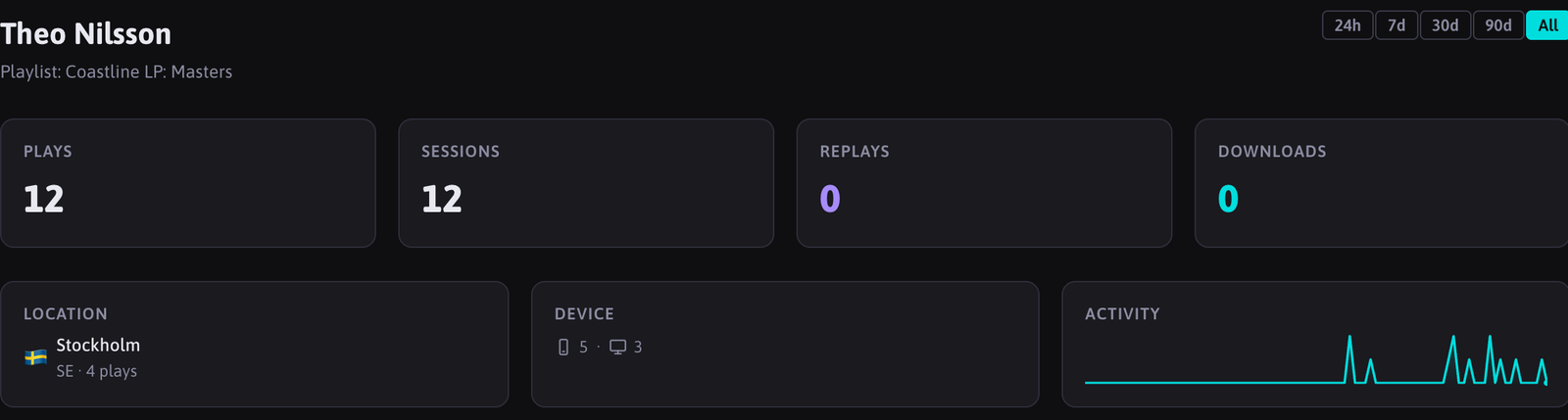
Who opened it, and when
The moment a listener presses play, the listen registers, tied to their link. You see the person, the track, and the time. No reply needed on their end, no action required. Opening the link is the signal.
From where, and on what device
Each listen also carries rough location and the device type. Whether the person opened your demo on a phone on the move or at a desk on a laptop tells you something about how much attention it got, and confirms the play came from who you expected rather than a forwarded link.
How much of the track they actually heard
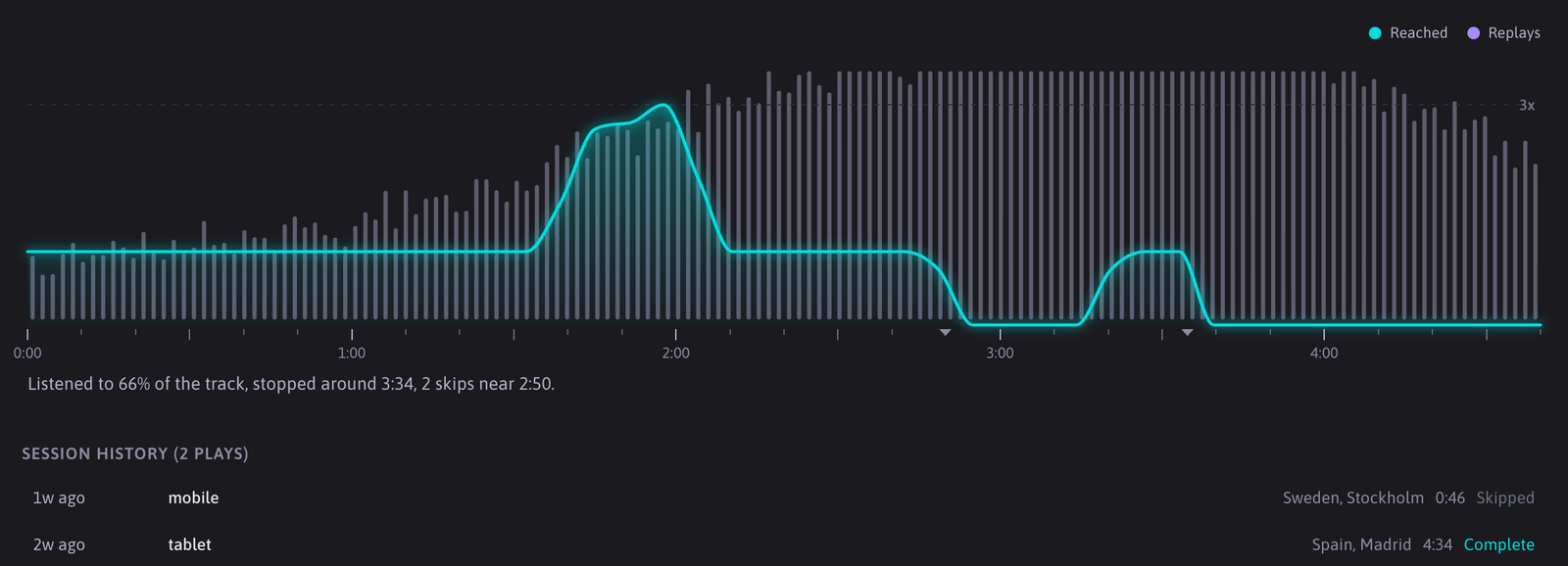
This is the one that matters most, and the one almost nothing else gives you. trakk'em records how far into the track each listener got. A play that reaches the end is a very different message from a play that stops at the first fifteen seconds. You stop guessing whether the intro is too long, because you can see exactly where people leave.
Which parts they replayed, and which they skipped
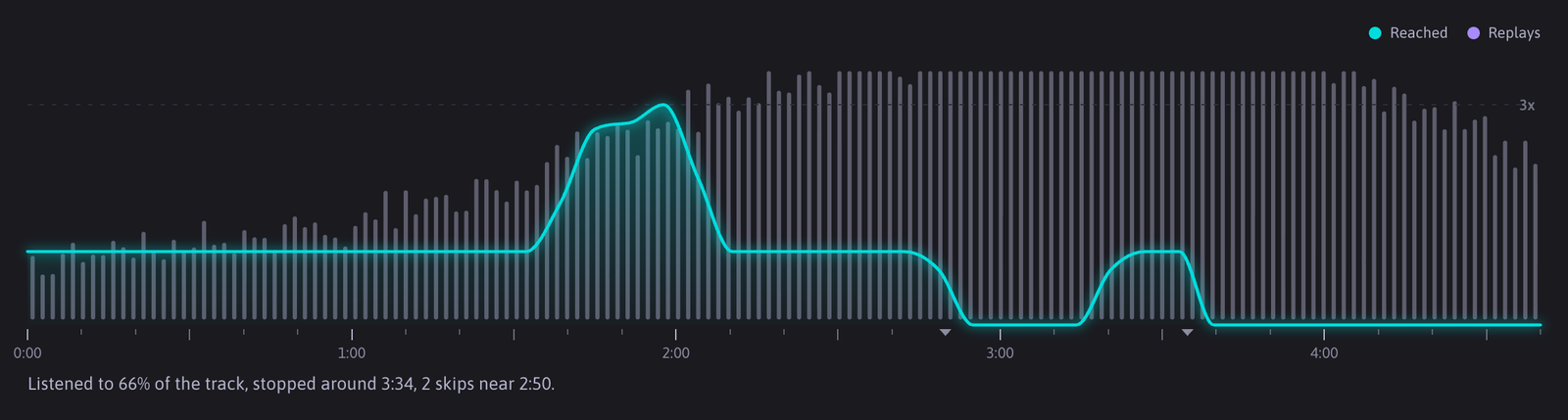
Beyond a single completion number, trakk'em builds a per-section picture of the track: the parts listeners replay, and the parts they skip past. If everyone rewinds the same eight bars, you have found your hook. If everyone jumps the bridge, you have found your problem. That is feedback you normally only get by asking, except nobody has to say a word.
Live, while it is happening
There is even a live "playing now" state, so when a listener is in your track at this moment, you can see it in real time. Watching an A&R actually sit inside your song is a different feeling from hoping they did.
Reading the signals without fooling yourself
Data is only useful if you read it honestly. A few guardrails.
- One open is information, not a verdict. Someone opening on a phone for twenty seconds may just be triaging their inbox. Look at the pattern over days, not the first ping.
- Completion beats opens. Ten opens that all stop at fifteen seconds is a worse sign than one open that plays the whole thing twice. Weight how much they heard over how many times they clicked.
- Skips are a gift. The section everyone leaves is not an insult, it is the exact place to spend your next studio session.
- Silence with data is still an answer. If the link shows they listened to the whole track and still did not reply, that is a real, useful "no", and it saves you from chasing a maybe.
Do you need any of this?
Not everyone does. If you post music publicly and want reach, a total play count on an open platform is fine, and something like SoundCloud is built for exactly that. Per-listener tracking is for the other situation: private delivery to specific people whose reaction actually decides something for you. Pitching a label. Sending mixes to a client. Getting a collaborator's real read before release.
If that is you, the silence after you hit send is not something you have to accept. Give each listener their own link, and the answer comes back on its own.
Ready to see who is really listening? See the plans and send your first tracked link in a couple of minutes.