
If you mix, master, or produce for other people, you live inside a loop: send a version, wait, decode the reply, revise, repeat. The mixing is the part you trained for. The loop around it, the sending, the chasing, the "sounds good but can the vocal be more, like, present?": that is where evenings disappear.
Most engineers run this loop over WeTransfer links and email threads. It works, in the way a shopping cart with a broken wheel works. Here is how to make the delivery side of client work as professional as the audio side.
Why the courier loop leaks time
- "Did you get it?" The eternal opener. A download link tells you nothing, so day three arrives and you genuinely do not know whether the client is slow to listen or slow to reply. You end up writing the awkward nudge either way.
- Version chaos.
Mix_v3_FINAL_revised2.wavin a thread with nine attachments. The client plays an old version, gives notes on a fixed problem, and everyone loses an afternoon. - Feedback with no coordinates. "The middle section feels empty." Which middle? 1:40 or 2:20? You mix from a timeline; their notes arrive from memory.
- Expired links and re-sends. The client finally sits down on Sunday, the Tuesday link is dead, and your delivery restarts with an apology.
None of this is the client's fault. The pipeline gives them nothing to be precise with.
The link-per-client way
Swap the courier for a private streaming link, one per client, and the loop tightens on its own. On trakk'em it looks like this:
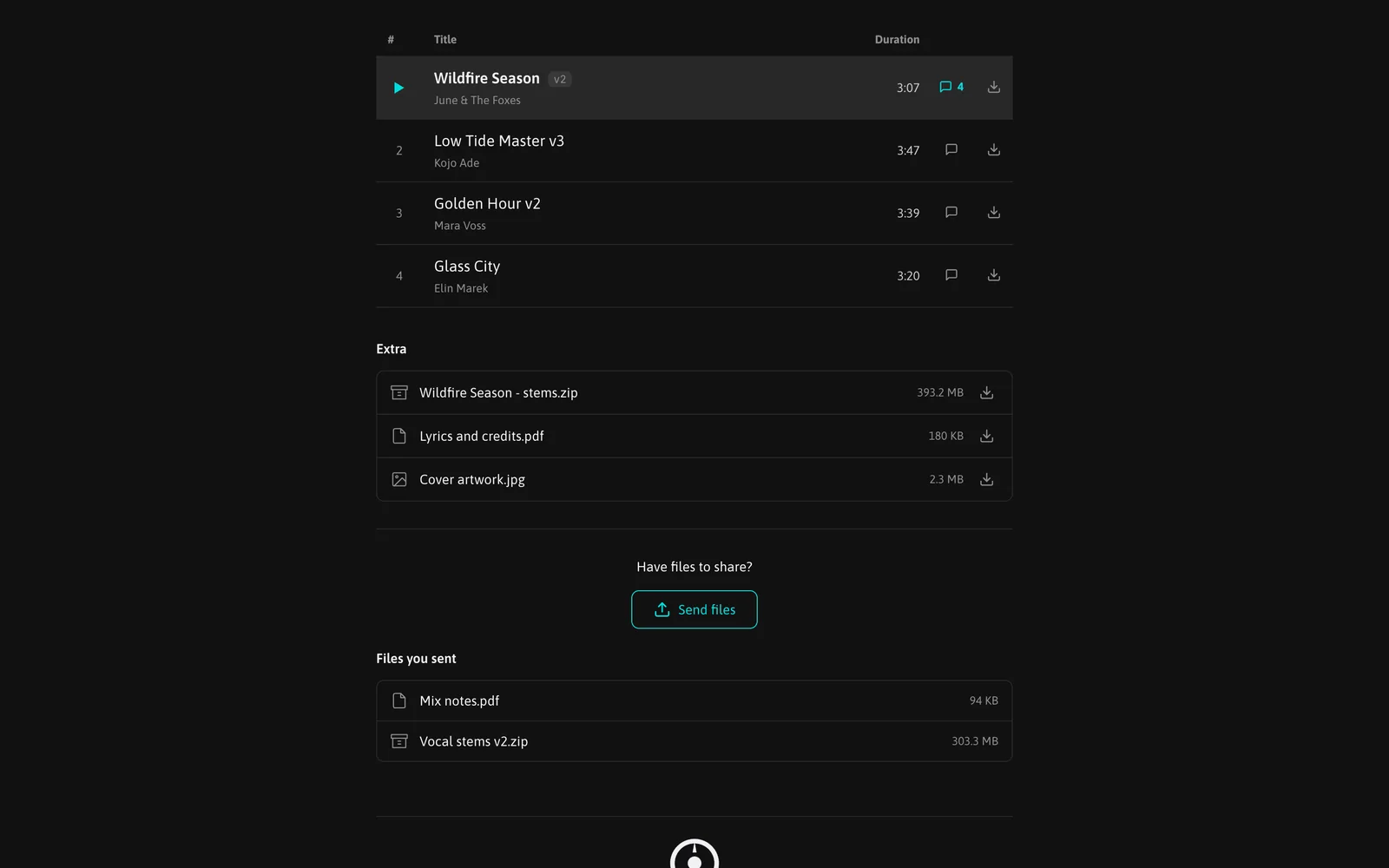
- One place, always current. The client's link opens a clean player with the track, your artwork, and notes. New version ready? Update what the link serves: nobody digs through a thread looking for the right attachment.
- Full quality, no downloads by default. The mix streams exactly as you bounced it, and the file itself moves only when you decide it should: relevant when the final master is the deliverable you invoice on.
- You see the listen happen. The moment the client presses play, you know, without asking. There is even a live "playing now" state: you can literally see them inside the mix.
The part that changes the actual work: seeing how they listened
Here is where tracked delivery goes beyond convenience. Per-listener tracking records not just that the client played the mix, but which parts they played, replayed, and skipped: drawn as a curve over the waveform.
For client work this is quietly transformative:
- The replayed section is the note they couldn't write. A client who scrubbed the second chorus five times is telling you where their attention is stuck: before the feedback email even arrives, you know which minute it will be about.
- The skipped section is a mix note too. If they jump the same passage on every listen, that passage is not holding them, and "make it more exciting" suddenly has coordinates.
- Device context prevents wild goose chases. "Not enough low end", listened on a phone, is a different conversation from the same note off studio monitors. You see the device with each listen.
- Depth of listening calibrates the revision. Full plays, twice, then notes: take every word seriously. Forty seconds on a phone between meetings: maybe wait for the real listen before rebalancing the entire low-mids.
We unpack this way of reading listens in which part of your song makes people skip: the same instrument, pointed at revisions instead of hooks.
A tighter loop, in practice
- Bounce the version, upload, send each stakeholder their own link (artist, label contact, manager: separate links, so you know whose listen is whose).
- Watch opens instead of asking. No listen after a few days? Nudge with confidence: they genuinely have not heard it.
- When notes arrive, read them next to the listen data: what they replayed, where they bailed, what device.
- Ship the revision to the same link. The old version can no longer be played by mistake.
The loop still runs on trust and good ears: it always will. But every dead spot in it, the guessing, the version confusion, the feedback without coordinates, was a delivery problem, not a people problem. Fix the delivery and the evenings come back.
Mixing for clients? See the plans and send your next version on a link that reports back.